
AS9100 Certification Cost: What Aerospace Companies Should Expect
How Much Does AS9100 Certification Cost?
If you’re evaluating AS9100 certification, cost is one of the first questions — and one of the most misunderstood.
AS9100 certification cost is not a single number. It is a structured investment across consulting, certification audits, internal effort, and ongoing system maintenance.
For aerospace organizations, the objective is not minimizing cost. It is building a system that enables contract eligibility while avoiding audit risk and rework.
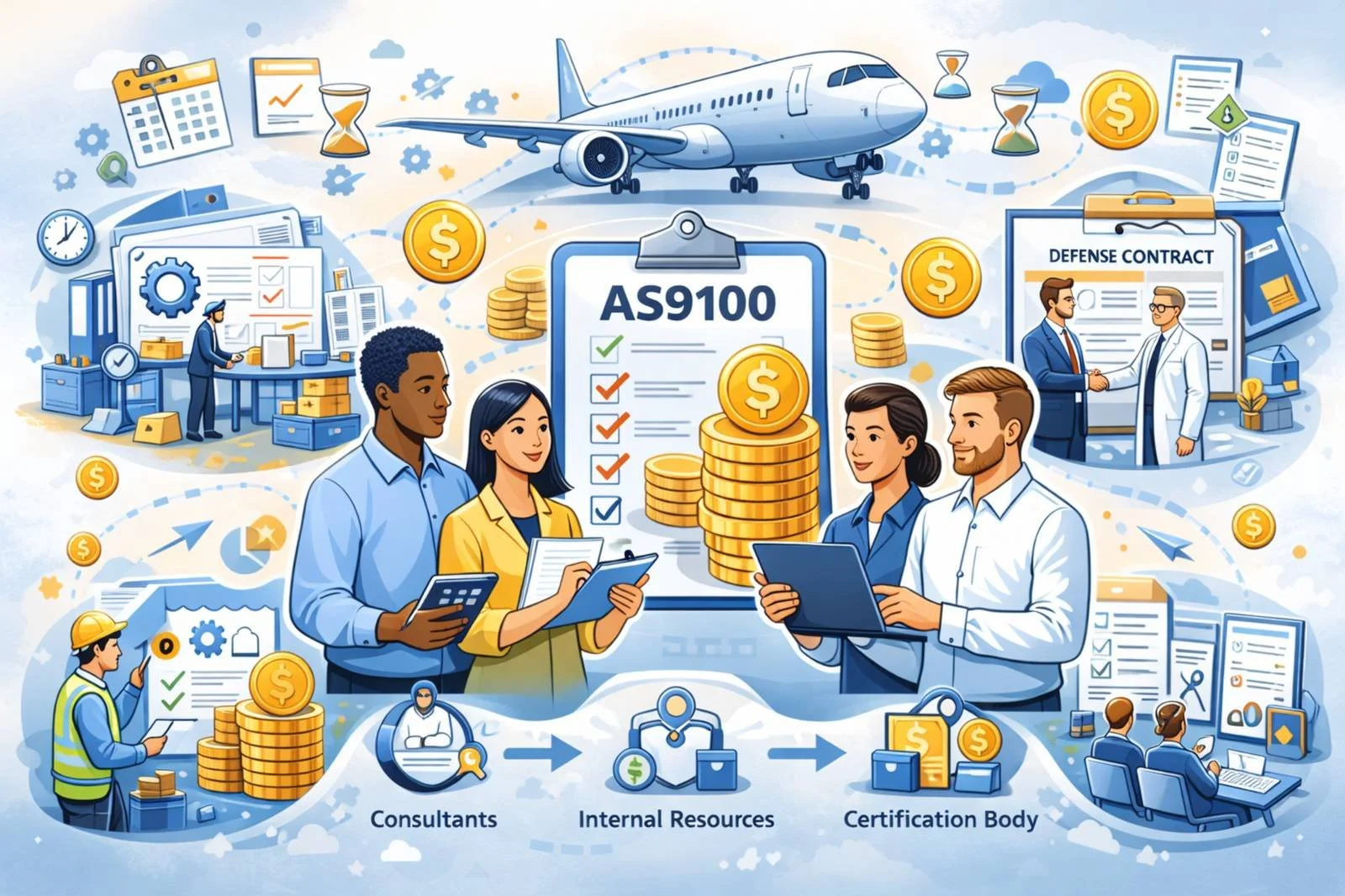
What Drives AS9100 Certification Cost
AS9100 certification cost is influenced by four primary categories:
Consulting and implementation support
Certification body (registrar) audit fees
Internal resource and operational costs
Ongoing surveillance and system maintenance
Each category contributes differently depending on your organization’s size, maturity, and complexity.
Consulting and Implementation Costs
Implementation support is typically the largest and most variable component.
Organizations engage structured support to reduce risk, accelerate timelines, and avoid audit failures. Many work with an AS9100 Certification Consultant to ensure the system is built correctly from the start.
Cost is influenced by:
Organizational size and structure
Inclusion of design and development (Clause 8.3)
Operational complexity and product risk
Number of locations
Existing QMS maturity
Internal resource availability
Typical Investment Ranges
Small aerospace startup (5–15 employees): $8,000 – $12,000
Mid-sized manufacturer (20–75 employees): $12,000 – $18,000
Complex or multi-site organizations: $18,000+
Organizations with an established ISO 9001 Consultant foundation typically reduce implementation cost and timeline.
If you are evaluating structured engagement models, AS9100 Implementation Services provide a defined pathway with controlled scope and milestones.
Certification Body (Registrar) Fees
Registrar fees are separate from consulting and are required for certification.
These fees are based on:
Employee count
Design inclusion
Audit duration (number of audit days)
Organizational risk classification
Multi-site complexity
Typical Ranges
Small organizations: $9,000 – $16,000
Mid-sized organizations: $16,000 – $30,000
Larger or multi-site organizations: Scaled based on audit duration
These costs typically include:
Stage 1 audit (readiness review)
Stage 2 audit (certification audit)
Certificate issuance
Surveillance audits (Years 2 and 3)
Understanding the full pathway through AS9100 Certification Process helps you anticipate how these costs are calculated.
Internal Resource and Operational Costs
Internal effort is often the most underestimated cost component.
AS9100 requires active participation across the organization, including:
Leadership involvement and management review
Risk management integration
Internal audit execution
Process definition and documentation updates
Employee training and awareness
Supplier evaluation and oversight
Typical internal allocation includes:
5–15% of leadership capacity during implementation
A dedicated or partially dedicated quality resource
If internal audit capability is limited, ISO Internal Audit Services can reduce audit risk and stabilize readiness.
Ongoing Surveillance and Maintenance Costs
Certification is not a one-time event.
Maintaining AS9100 requires:
Annual surveillance audits
Internal audit program execution
Corrective action and continual improvement
Risk monitoring and updates
Management review cycles
Typical Annual Cost Range
$8,000 – $20,000+ depending on size and system complexity
Organizations that treat AS9100 as an operational management system — rather than a compliance artifact — typically reduce long-term disruption and cost variability.
What Increases AS9100 Certification Cost
Cost increases when system maturity is low or operational complexity is high.
Common cost drivers include:
No existing QMS structure
Inconsistent or incomplete documentation
Limited leadership engagement
Weak supplier controls
Complex design and development activities
Multi-site operations
Prior audit failures or major nonconformities
Organizations evaluating system alignment often review ISO 9001 vs AS9100 to understand structural differences before committing to certification.
How Timeline Affects Cost
Implementation timeline directly impacts cost.
Typical ranges:
4–6 months — strong existing ISO 9001 system
6–9 months — moderate system maturity
9–12 months — building from scratch
Compressed timelines increase consulting intensity and internal disruption.
Reviewing AS9100 Certification Requirements early reduces rework and stabilizes execution.
The Strategic Perspective on Cost
The more relevant question is not:
“How much does AS9100 certification cost?”
It is:
“What is the cost of not being eligible for aerospace contracts?”
For many organizations, a single contract outweighs the total certification investment.
AS9100 should be treated as a revenue-enabling system — not a compliance expense.
How We Help Control Certification Cost
Cost control comes from disciplined implementation, not shortcuts.
We focus on:
Right-sized documentation aligned to operations
Avoiding unnecessary system complexity
Integrating with existing workflows
Reducing audit findings and rework
Accelerating evidence development
Structuring realistic implementation timelines
If you are selecting a partner, evaluating the role of an AS9100 Certification Consultant helps ensure the system is built for both audit success and operational use.
Frequently Asked Questions
Is AS9100 more expensive than ISO 9001?
Yes. AS9100 introduces additional requirements including product safety, configuration management, and counterfeit part prevention.
Can we implement AS9100 without a consultant?
Yes. However, structured support typically reduces timeline, audit findings, and overall risk.
Does employee count affect cost?
Yes. Certification bodies calculate audit duration partly based on employee count, which directly impacts cost.
Why This Matters
AS9100 certification cost is not just a budget line item.
It reflects:
System maturity
Operational discipline
Audit readiness
Contract eligibility
Organizations that approach certification strategically convert that investment into long-term capability.
If You’re Also Evaluating…
Cost is only one variable.
System structure determines whether that investment becomes an asset or a constraint.
Contact us.
info@wintersmithadvisory.com
(801) 477-6329