
Enterprise Risk Management Consulting
Build Resilience with Integrated Risk Governance
Enterprise Risk Management Consulting helps organizations identify, evaluate, and manage risks that can disrupt operations or weaken strategic performance. Wintersmith Advisory designs structured Enterprise Risk Management (ERM) programs that integrate governance, risk oversight, and strategic planning.
Rather than treating risk as a compliance exercise, ERM establishes a management discipline that supports better decisions across leadership teams, departments, and operational functions. A well-designed program also replaces intuition and anecdotal judgment with risk decisions that are measurable, documented, and defensible to customers and regulators.
Our approach draws on globally recognized frameworks such as COSO ERM and the principles described in ISO 31000 Consultant guidance. The objective is straightforward: create systems that allow leadership teams to understand risk exposure, prioritize mitigation, and make confident strategic decisions.
Organizations implementing ERM frequently integrate these frameworks alongside broader governance and compliance initiatives supported through ISO Risk Management Consulting.
Why Enterprise Risk Management Matters
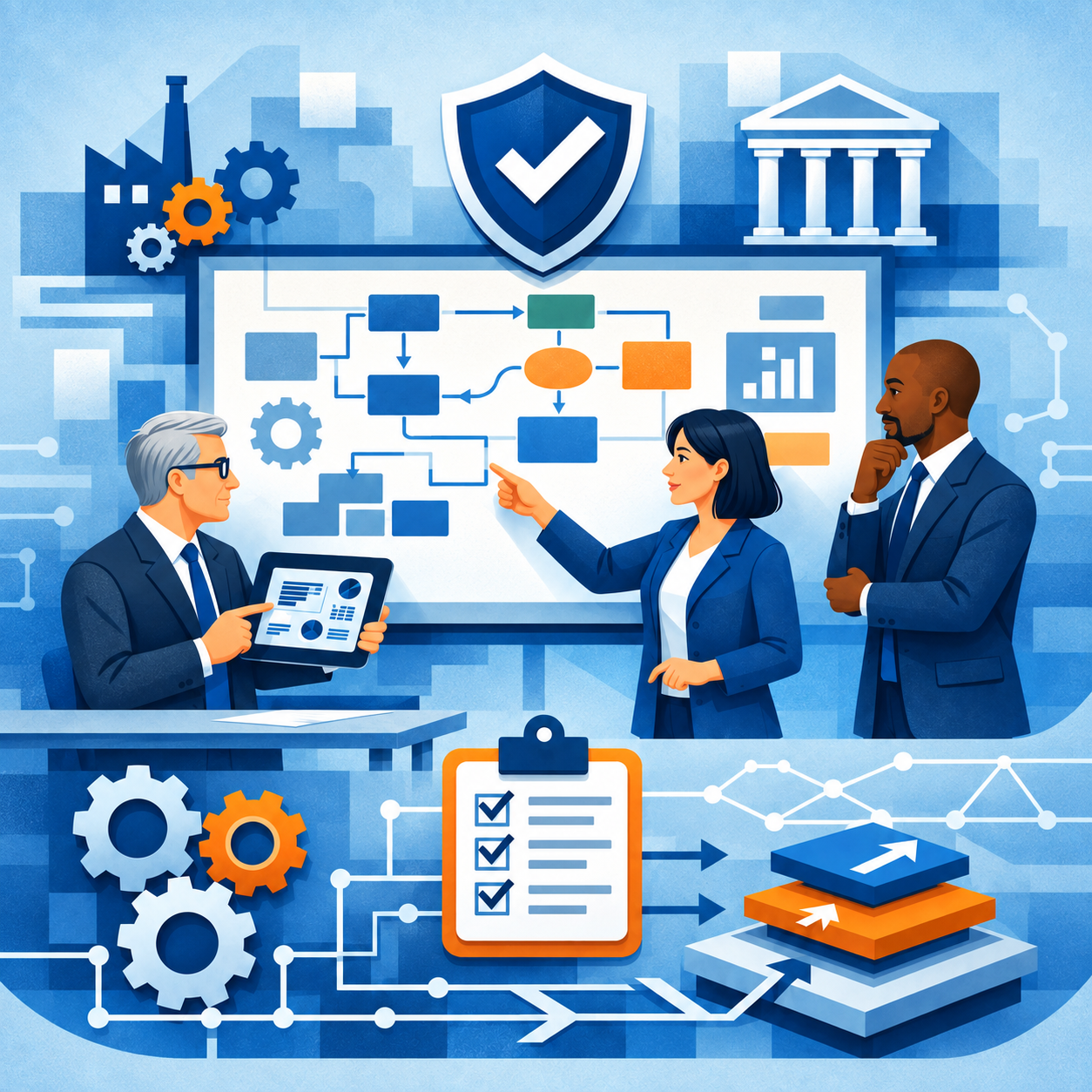
Modern organizations operate in environments shaped by regulatory complexity, global supply chains, cybersecurity exposure, and operational interdependencies. Without structured oversight, these risks accumulate quietly until they disrupt performance. Many companies manage risk informally instead, with departments tracking issues independently and leadership receiving fragmented reporting — a pattern that creates governance blind spots.
Enterprise Risk Management introduces transparency and discipline across the organization.
Key Outcomes of an ERM Program
Improved visibility into operational, regulatory, and strategic risks
Structured decision-making aligned with leadership objectives
Reduced likelihood of operational disruption or compliance failures
Stronger governance and accountability across departments
Increased confidence among stakeholders, regulators, and customers
A consistent, defensible methodology for evaluating threats across the organization
For organizations implementing structured compliance programs, ERM often complements initiatives such as ISO Compliance Consulting or broader ISO Management System Consulting, where risk-based thinking becomes a foundational governance principle.
The Wintersmith ERM Implementation Approach
Enterprise Risk Management programs must be practical, structured, and aligned with leadership priorities. Wintersmith Advisory builds ERM systems that are scalable and embedded into everyday management activities.
Initial Framework Design & Governance Alignment
The first phase focuses on establishing the ERM structure and defining how risk governance will operate.
Key activities include:
Establishing ERM scope and governance structure
Defining leadership oversight and risk ownership roles
Aligning ERM objectives with business strategy
Designing the organization’s ERM framework and methodology
Organizations already operating structured management systems often integrate ERM within broader governance programs supported by an Integrated ISO Management Consultant.
Risk Identification & Prioritization
Effective ERM begins with identifying risks that could meaningfully impact the organization’s objectives. Facilitated workshops bring together executive leadership, operations, IT and cybersecurity, compliance and legal, quality management, and finance to surface both strategic and operational exposure.
This phase focuses on:
Facilitated risk identification workshops across functions
Development of structured risk registers
Risk scoring based on likelihood and impact
Evaluation of strategic, operational, regulatory, cybersecurity, financial, supply chain, and safety risk categories
Identification of emerging strategic risks
The outcome is a prioritized view of risks requiring mitigation planning and leadership oversight.
Risk Assessment Methodologies & Treatment Planning
Once risks are identified, Wintersmith applies structured methodologies so that scoring is repeatable and defensible rather than anecdotal:
Qualitative risk scoring matrices
Quantitative impact analysis
Scenario analysis and disruption modeling
Business impact assessment
Control effectiveness evaluation, often validated through Conducting an Audit
Residual risk determination
Each risk is then matched to a treatment strategy: mitigation through improved controls, transfer through insurance or contractual mechanisms, avoidance through operational change, or acceptance when exposure falls within tolerance. Documenting the rationale behind each choice keeps leadership decisions traceable and gives risk oversight the same rigor organizations expect from broader Governance Risk and Compliance programs.
Risk Indicators, Registers & Assessment Tools
A successful ERM program requires tools that allow leadership teams to monitor risk exposure over time.
Wintersmith develops practical governance tools including:
Risk registers aligned with organizational structure
Key Risk Indicator (KRI) frameworks
Assessment templates and evaluation models
Executive dashboards for risk monitoring
Reporting frameworks for leadership oversight
These tools support continuous monitoring rather than one-time assessments.
Strategic Planning Integration
Enterprise Risk Management becomes most valuable when integrated with strategy development and operational planning. This phase focuses on aligning ERM with leadership decision-making.
Key integration activities include:
Incorporating risk analysis into strategic planning
Identifying risk exposure related to major initiatives
Aligning mitigation planning with operational management
Conducting leadership workshops on risk-informed decision making
Organizations implementing structured governance frameworks frequently connect ERM with broader operational programs supported through ISO Implementation Services.
Implementation & Organizational Training
ERM programs must be adopted across the organization to function effectively.
Implementation activities typically include:
Executive risk governance workshops
Department-level ERM training sessions
Integration of risk management into operational processes
Development of internal risk management procedures
Support for ongoing program governance
Organizations building internal governance capability often complement these initiatives with programs such as ISO Internal Auditor Training to strengthen internal oversight practices.
Monitoring, Reporting & Continuous Improvement
Risk governance is not static. Effective ERM programs evolve as organizations grow and risk environments change.
Monitoring activities include:
Regular risk register reviews
Ongoing Key Risk Indicator monitoring
Executive risk committee reviews
ERM program maturity assessments
Continuous improvement planning
Companies seeking long-term governance stability frequently integrate these activities into structured lifecycle services such as Maintaining a System. The objective is to ensure the ERM system remains aligned with strategic priorities and emerging risk exposure.
Risk-Based Thinking Across ISO Management Systems
Risk-based thinking is a formal requirement across most modern management system standards, including quality management, environmental management, occupational health and safety, information security, and business continuity. Organizations that already maintain a certified system — such as an ISO 9001 Quality Management System — gain an advantage here: their existing risk registers and controls become inputs to the ERM program rather than a separate exercise, giving multi-standard organizations one coherent view of risk instead of several disconnected ones.
Deliverables Clients Can Expect
Organizations working with Wintersmith Advisory typically receive a complete ERM system tailored to their operational environment.
Key deliverables include:
Enterprise Risk Governance Framework
Prioritized organizational risk register
Risk assessment methodologies and scoring models
Key Risk Indicator monitoring framework
Executive reporting dashboards
Risk management templates and implementation tools
ERM training materials and workshop guides
Final advisory report with strategic recommendations
Each deliverable is designed to remain usable long after the engagement concludes.
Who This Service Is For
Enterprise Risk Management is particularly valuable for organizations operating in complex regulatory or operational environments.
Typical client profiles include:
Mid-size and enterprise manufacturers
Aerospace and defense supply chain organizations
Technology and cybersecurity-focused firms
Biotech and medical device companies
Service organizations managing complex operational risk
Organizations managing multiple operational sites or business units
Organizations that must demonstrate governance to customers or regulators
Many organizations implement ERM alongside governance frameworks supported by an ISO Consultant to ensure consistency between operational management systems and strategic oversight.
Work Directly with the Principal Consultant
All Enterprise Risk Management engagements are led directly by the principal consultant at Wintersmith Advisory.
This approach ensures:
Senior-level advisory engagement throughout the project
Practical implementation guidance rather than theoretical models
Alignment with broader governance and compliance initiatives
Clear, actionable recommendations for leadership teams
Direct senior involvement also avoids the failures that undermine risk programs run informally — risk identification without structured scoring, registers that are built once and never updated, mitigation plans with no assigned owner, and risk treated as a one-time compliance exercise rather than an ongoing governance discipline. Wintersmith Advisory approaches ERM as a long-term governance capability rather than a short-term consulting exercise.
Frequently Asked Questions
What is the difference between risk assessment and enterprise risk management?
Risk assessment is the structured process of identifying, analyzing, and scoring individual risks. Enterprise Risk Management is the broader governance program that embeds risk assessment into strategic planning, leadership decision-making, and ongoing monitoring across the organization.
What types of risks does an enterprise risk assessment evaluate?
A structured assessment typically evaluates strategic, operational, regulatory and compliance, cybersecurity and information security, financial, supply chain, and environmental or safety risks, scored by likelihood and potential impact.
How are risks prioritized in an ERM program?
Risks are scored using qualitative or quantitative methods, ranked in a structured risk register, and matched to a treatment strategy — mitigation, transfer, avoidance, or acceptance — based on organizational risk tolerance.
Is Enterprise Risk Management only for large organizations?
No. Mid-size manufacturers, technology firms, and other growing organizations use ERM to bring structure to risk decisions before informal, fragmented risk tracking becomes a governance liability.
Next Strategic Considerations
Organizations evaluating Enterprise Risk Management often explore related governance and management system initiatives:
These initiatives often complement ERM by strengthening operational governance, compliance oversight, and strategic resilience across the organization.Why Enterprise Risk Management Matters
Modern organizations operate in environments shaped by regulatory complexity, global supply chains, cybersecurity exposure, and operational interdependencies. Without structured oversight, these risks accumulate quietly until they disrupt performance. Many companies manage risk informally instead, with departments tracking issues independently and leadership receiving fragmented reporting — a pattern that creates governance blind spots.
Enterprise Risk Management introduces transparency and discipline across the organization.
Key Outcomes of an ERM Program
Improved visibility into operational, regulatory, and strategic risks
Structured decision-making aligned with leadership objectives
Reduced likelihood of operational disruption or compliance failures
Stronger governance and accountability across departments
Increased confidence among stakeholders, regulators, and customers
A consistent, defensible methodology for evaluating threats across the organization
For organizations implementing structured compliance programs, ERM often complements initiatives such as ISO Compliance Consulting or broader ISO Management System Consulting, where risk-based thinking becomes a foundational governance principle.
The Wintersmith ERM Implementation Approach
Enterprise Risk Management programs must be practical, structured, and aligned with leadership priorities. Wintersmith Advisory builds ERM systems that are scalable and embedded into everyday management activities.
Initial Framework Design & Governance Alignment
The first phase focuses on establishing the ERM structure and defining how risk governance will operate.
Key activities include:
Establishing ERM scope and governance structure
Defining leadership oversight and risk ownership roles
Aligning ERM objectives with business strategy
Designing the organization’s ERM framework and methodology
Organizations already operating structured management systems often integrate ERM within broader governance programs supported by an Integrated ISO Management Consultant.
Risk Identification & Prioritization
Effective ERM begins with identifying risks that could meaningfully impact the organization’s objectives. Facilitated workshops bring together executive leadership, operations, IT and cybersecurity, compliance and legal, quality management, and finance to surface both strategic and operational exposure.
This phase focuses on:
Facilitated risk identification workshops across functions
Development of structured risk registers
Risk scoring based on likelihood and impact
Evaluation of strategic, operational, regulatory, cybersecurity, financial, supply chain, and safety risk categories
Identification of emerging strategic risks
The outcome is a prioritized view of risks requiring mitigation planning and leadership oversight.
Risk Assessment Methodologies & Treatment Planning
Once risks are identified, Wintersmith applies structured methodologies so that scoring is repeatable and defensible rather than anecdotal:
Qualitative risk scoring matrices
Quantitative impact analysis
Scenario analysis and disruption modeling
Business impact assessment
Control effectiveness evaluation, often validated through Conducting an Audit
Residual risk determination
Each risk is then matched to a treatment strategy: mitigation through improved controls, transfer through insurance or contractual mechanisms, avoidance through operational change, or acceptance when exposure falls within tolerance. Documenting the rationale behind each choice keeps leadership decisions traceable and gives risk oversight the same rigor organizations expect from broader Governance Risk and Compliance programs.
Risk Indicators, Registers & Assessment Tools
A successful ERM program requires tools that allow leadership teams to monitor risk exposure over time.
Wintersmith develops practical governance tools including:
Risk registers aligned with organizational structure
Key Risk Indicator (KRI) frameworks
Assessment templates and evaluation models
Executive dashboards for risk monitoring
Reporting frameworks for leadership oversight
These tools support continuous monitoring rather than one-time assessments.
Strategic Planning Integration
Enterprise Risk Management becomes most valuable when integrated with strategy development and operational planning. This phase focuses on aligning ERM with leadership decision-making.
Key integration activities include:
Incorporating risk analysis into strategic planning
Identifying risk exposure related to major initiatives
Aligning mitigation planning with operational management
Conducting leadership workshops on risk-informed decision making
Organizations implementing structured governance frameworks frequently connect ERM with broader operational programs supported through ISO Implementation Services.
Implementation & Organizational Training
ERM programs must be adopted across the organization to function effectively.
Implementation activities typically include:
Executive risk governance workshops
Department-level ERM training sessions
Integration of risk management into operational processes
Development of internal risk management procedures
Support for ongoing program governance
Organizations building internal governance capability often complement these initiatives with programs such as ISO Internal Auditor Training to strengthen internal oversight practices.
Monitoring, Reporting & Continuous Improvement
Risk governance is not static. Effective ERM programs evolve as organizations grow and risk environments change.
Monitoring activities include:
Regular risk register reviews
Ongoing Key Risk Indicator monitoring
Executive risk committee reviews
ERM program maturity assessments
Continuous improvement planning
Companies seeking long-term governance stability frequently integrate these activities into structured lifecycle services such as Maintaining a System. The objective is to ensure the ERM system remains aligned with strategic priorities and emerging risk exposure.
Risk-Based Thinking Across ISO Management Systems
Risk-based thinking is a formal requirement across most modern management system standards, including quality management, environmental management, occupational health and safety, information security, and business continuity. Organizations that already maintain a certified system — such as an ISO 9001 Quality Management System — gain an advantage here: their existing risk registers and controls become inputs to the ERM program rather than a separate exercise, giving multi-standard organizations one coherent view of risk instead of several disconnected ones.
Deliverables Clients Can Expect
Organizations working with Wintersmith Advisory typically receive a complete ERM system tailored to their operational environment.
Key deliverables include:
Enterprise Risk Governance Framework
Prioritized organizational risk register
Risk assessment methodologies and scoring models
Key Risk Indicator monitoring framework
Executive reporting dashboards
Risk management templates and implementation tools
ERM training materials and workshop guides
Final advisory report with strategic recommendations
Each deliverable is designed to remain usable long after the engagement concludes.
Who This Service Is For
Enterprise Risk Management is particularly valuable for organizations operating in complex regulatory or operational environments.
Typical client profiles include:
Mid-size and enterprise manufacturers
Aerospace and defense supply chain organizations
Technology and cybersecurity-focused firms
Biotech and medical device companies
Service organizations managing complex operational risk
Organizations managing multiple operational sites or business units
Organizations that must demonstrate governance to customers or regulators
Many organizations implement ERM alongside governance frameworks supported by an ISO Consultant to ensure consistency between operational management systems and strategic oversight.
Work Directly with the Principal Consultant
All Enterprise Risk Management engagements are led directly by the principal consultant at Wintersmith Advisory.
This approach ensures:
Senior-level advisory engagement throughout the project
Practical implementation guidance rather than theoretical models
Alignment with broader governance and compliance initiatives
Clear, actionable recommendations for leadership teams
Direct senior involvement also avoids the failures that undermine risk programs run informally — risk identification without structured scoring, registers that are built once and never updated, mitigation plans with no assigned owner, and risk treated as a one-time compliance exercise rather than an ongoing governance discipline. Wintersmith Advisory approaches ERM as a long-term governance capability rather than a short-term consulting exercise.
Frequently Asked Questions
What is the difference between risk assessment and enterprise risk management?
Risk assessment is the structured process of identifying, analyzing, and scoring individual risks. Enterprise Risk Management is the broader governance program that embeds risk assessment into strategic planning, leadership decision-making, and ongoing monitoring across the organization.
What types of risks does an enterprise risk assessment evaluate?
A structured assessment typically evaluates strategic, operational, regulatory and compliance, cybersecurity and information security, financial, supply chain, and environmental or safety risks, scored by likelihood and potential impact.
How are risks prioritized in an ERM program?
Risks are scored using qualitative or quantitative methods, ranked in a structured risk register, and matched to a treatment strategy — mitigation, transfer, avoidance, or acceptance — based on organizational risk tolerance.
Is Enterprise Risk Management only for large organizations?
No. Mid-size manufacturers, technology firms, and other growing organizations use ERM to bring structure to risk decisions before informal, fragmented risk tracking becomes a governance liability.
Next Strategic Considerations
Organizations evaluating Enterprise Risk Management often explore related governance and management system initiatives:
These initiatives often complement ERM by strengthening operational governance, compliance oversight, and strategic resilience across the organization.
Contact us.
info@wintersmithadvisory.com
(801) 477-6329