
How Much Does ISO 27001 Certification Cost? A Practical 2026 Cost Breakdown
ISO 27001 certification is an investment — not a line-item expense.
If you're evaluating certification, the better questions are:
What are the external audit costs?
What internal resources will we allocate?
Do we need advisory support?
What does long-term maintenance look like?
Below is a realistic breakdown based on U.S.-based implementation projects.
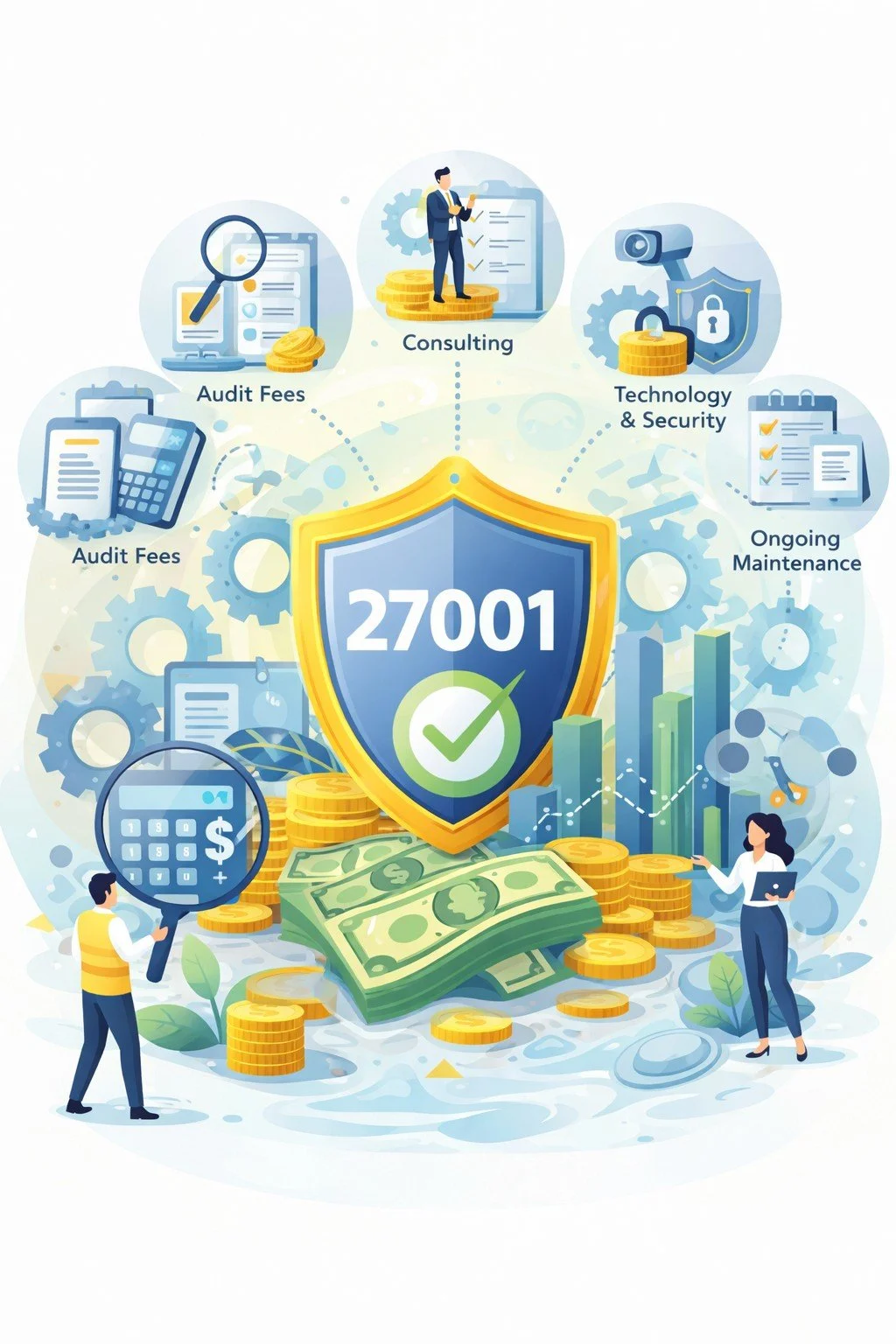
The Short Answer
For most small to mid-sized organizations in the United States, total first-year ISO 27001 certification cost typically ranges between:
$25,000 – $85,000+
The range depends on:
Organization size
Scope complexity
Number of employees
Number of locations
Existing security maturity
Cloud vs. on-prem architecture
Whether external support is used
If you're early in evaluation, reviewing the broader landscape of ISO 27001 Certification Consulting helps frame what support models exist and how they impact cost.
1. Certification Body Audit Fees
These are the fees paid directly to the accredited certification body for:
Stage 1 audit (documentation review)
Stage 2 audit (implementation verification)
Certification decision
Surveillance audits (Years 2 and 3)
Typical Audit Costs
Small company (10–25 employees, single site):
$8,000 – $15,000 over a 3-year cycle
Mid-size company (25–100 employees):
$15,000 – $30,000 over a 3-year cycle
Larger or multi-site organizations:
$30,000 – $60,000+
Audit duration is driven by IAF audit day tables based on headcount and operational complexity.
If you're evaluating registrars, understanding how an ISO 27001 Certification Company structures audit days can significantly influence your long-term cost model.
2. Consulting Costs (Optional, But Common)
Many organizations pursue ISO 27001 certification for the first time with structured advisory support.
Why?
Because ISO 27001 requires more than documentation. It requires:
Formalized risk assessment methodology
A defensible Statement of Applicability (SoA)
Control implementation alignment
Internal audit program design
Management review governance
Evidence preparation for audit
Typical Consulting Investment
Small company:
$12,000 – $18,000
Mid-size company:
$18,000 – $27,000
Complex or regulated environments:
$27,000+
Costs are influenced by:
Existing policy maturity
Prior alignment to SOC 2 or NIST frameworks
Internal ISMS ownership
Availability of leadership engagement
Organizations that already operate within a structured ISO Management System Consulting model often experience reduced implementation friction and lower advisory hours.
3. Internal Resource Costs (Often Overlooked)
This is the hidden cost category.
ISO 27001 requires internal participation from:
Executive leadership
IT and security teams
HR
Operations
Risk and asset owners
Even with external advisory support, your team will invest time in:
Risk workshops
Asset inventory development
Control implementation
Security awareness training
Internal audits
Management reviews
For many organizations, this equates to:
150 – 400 internal hours
Often translating to $10,000 – $40,000 in internal labor allocation.
This is why ISO 27001 is a strategic governance decision — not simply a compliance exercise.
Structured internal audit capability, supported by ISO Internal Audit Services, can significantly reduce disruption during surveillance cycles.
4. Technology and Control Investment
ISO 27001 does not mandate specific tools — it mandates effective controls.
Certification may expose gaps requiring investment in:
Multi-factor authentication
Logging and monitoring solutions
Endpoint detection
Vulnerability management
Backup and recovery architecture
Vendor risk management tooling
Some organizations require minimal upgrades.
Others may need:
$5,000 – $50,000+ in security tooling improvements.
The largest cost escalations typically occur when foundational controls are absent prior to project launch.
5. Ongoing Annual Maintenance Costs
ISO 27001 follows a three-year certification cycle.
After initial certification, organizations must maintain:
Annual surveillance audits
Internal audits
Risk reassessments
Management review
Continuous improvement processes
Typical ongoing annual costs:
$5,000 – $20,000 for audit and internal program support
More if ISMS management is fully outsourced.
Organizations that treat ISO 27001 as a living system maintain certification efficiently.
Organizations that treat it as a one-time milestone struggle during surveillance audits.
Integrated programs supported through disciplined ISO Compliance Services tend to reduce long-term cost volatility.
What Drives Cost the Most?
From practical experience, the largest cost drivers are:
1. Lack of Existing Structure
No asset inventory, no formal risk process, no control mapping — costs increase quickly.
2. Overly Broad Scope
Certifying the entire enterprise versus a defined business unit dramatically changes audit duration.
3. Weak Project Governance
Certification delays increase advisory hours and internal burn rate.
4. Significant Tooling Gaps
Major infrastructure deficiencies increase capital investment requirements.
Cost discipline starts with scope discipline.
How to Reduce ISO 27001 Certification Costs
Conduct a structured gap assessment before committing
Define scope strategically
Align with existing frameworks where possible
Assign a clear internal ISMS owner
Avoid “template-only” implementations
Plan audit timing carefully
The most expensive ISO 27001 projects are the ones that are rushed.
Is ISO 27001 Worth the Investment?
For many organizations, ISO 27001 enables:
Enterprise sales eligibility
Government contract qualification
Vendor approval acceleration
Reduced due diligence friction
Structured risk governance
Strengthened security posture
When pursued strategically, the return often exceeds the certification investment.
Final Perspective
For a small to mid-sized U.S. organization, realistic first-year investment typically falls between:
$25,000 – $85,000+
Larger or more complex environments may exceed that range.
The objective is not to minimize cost — it is to structure the project correctly from the beginning.
ISO 27001 certification is achievable, manageable, and scalable when implemented with disciplined governance and a clear scope.
If You’re Also Evaluating…
Contact us.
info@wintersmithadvisory.com
(801) 477-6329