
ISO 9001 vs Lean Manufacturing
Organizations improving operational performance often encounter two major frameworks: ISO 9001 and Lean Manufacturing.
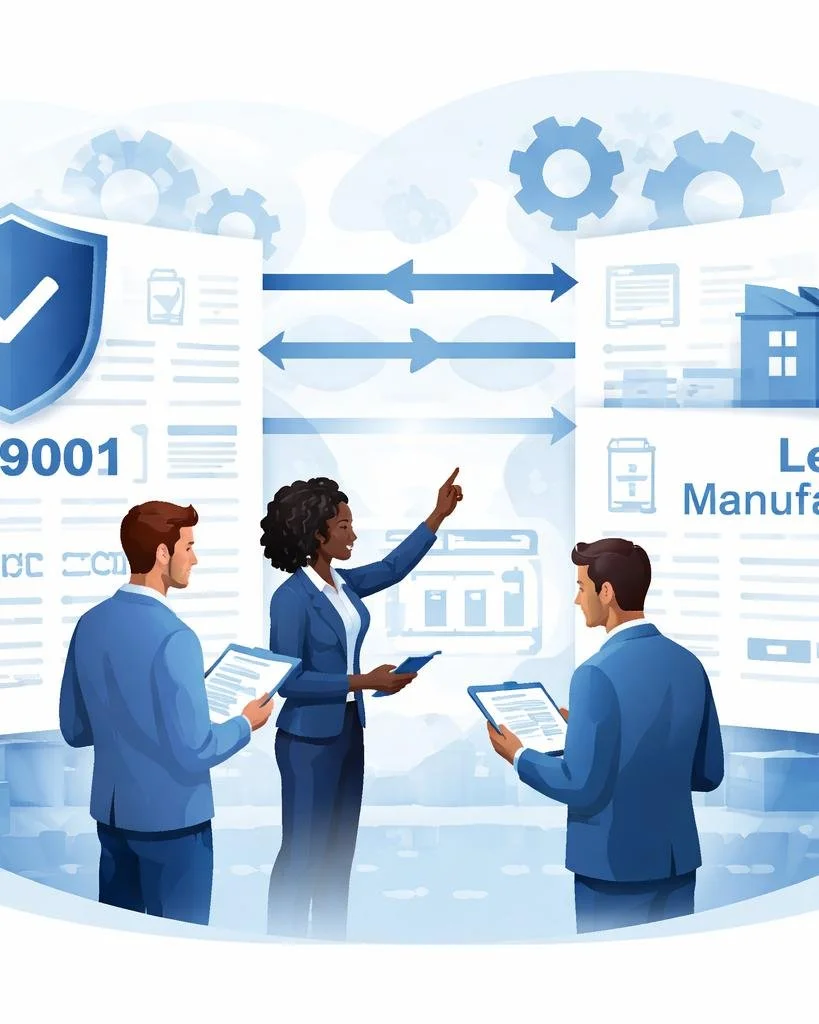
Although both aim to improve quality and efficiency, they serve fundamentally different roles in organizational governance.
ISO 9001 is a management system standard that establishes a structured framework for quality management across an entire organization.
Lean Manufacturing is an operational methodology focused on eliminating waste, improving flow, and maximizing customer value in production processes.
Understanding the difference between these approaches helps organizations determine whether they should adopt one, the other, or both.
Many organizations first build a formal governance structure through ISO 9001 Quality Management System implementation before introducing Lean initiatives to improve operational efficiency.
What Is ISO 9001?
ISO 9001 is the international standard for quality management systems (QMS).
It defines requirements for how organizations manage processes, control risks, monitor performance, and continually improve operations.
ISO 9001 does not prescribe specific operational methods. Instead, it creates a governance framework that ensures quality is managed systematically across the business.
Organizations typically implement the standard with support from an ISO 9001 Consultant to ensure that leadership responsibilities, process controls, and documentation align with certification requirements.
Core elements of ISO 9001 include:
Leadership accountability for quality performance
Process-based operational management
Risk-based thinking in planning and operations
Documented procedures and records
Internal audits and management reviews
Corrective action and continual improvement
Organizations pursuing certification normally work through structured ISO 9001 Implementation activities to align processes, documentation, and governance with the standard.
ISO 9001 focuses on system discipline rather than operational techniques.
What Is Lean Manufacturing?
Lean Manufacturing is a continuous improvement methodology designed to eliminate waste in production processes.
Originally developed within the Toyota Production System, Lean focuses on improving process efficiency by removing non-value-added activities.
Lean initiatives concentrate primarily on operational flow and resource utilization.
Common Lean principles include:
Identifying customer-defined value
Mapping the value stream
Eliminating process waste
Creating continuous flow
Establishing pull-based production
Pursuing continuous improvement
Lean is not a certifiable management system like ISO 9001.
Instead, it is a collection of operational improvement tools and philosophies that organizations apply within their production environments.
Many organizations introduce Lean practices after establishing stable governance through ISO 9001 Consulting Services to ensure process improvements occur within a controlled management system.
The Core Difference Between ISO 9001 and Lean Manufacturing
The primary distinction lies in their scope and purpose.
ISO 9001 governs how the organization manages quality across all processes.
Lean Manufacturing focuses specifically on improving process efficiency and eliminating operational waste.
ISO 9001 addresses organizational structure and accountability.
Lean addresses operational performance and efficiency.
ISO 9001 typically requires formal documentation, internal auditing, and management review.
Lean focuses on visual management, problem-solving, and frontline process improvement.
Organizations evaluating certification readiness often begin with an ISO Gap Assessment to determine whether existing operational improvement efforts align with ISO 9001 requirements.
ISO 9001 vs Lean Manufacturing: Key Differences
Although they pursue similar outcomes—better quality and efficiency—their mechanisms differ significantly.
Key differences include:
ISO 9001 establishes a quality management governance framework
Lean Manufacturing improves operational flow and waste reduction
ISO 9001 is an internationally recognized certifiable standard
Lean is a methodology rather than a formal certification standard
ISO 9001 covers all organizational processes
Lean primarily focuses on production and operational workflows
ISO 9001 requires formal auditing and documentation
Lean emphasizes visual management and team-based improvement
These distinctions mean that Lean cannot replace ISO 9001 governance, and ISO 9001 alone does not provide the operational improvement tools Lean offers.
Organizations typically combine both approaches to achieve stronger results.
How ISO 9001 Supports Lean Manufacturing
ISO 9001 provides the governance structure that enables Lean initiatives to scale across an organization.
Without a management system, Lean improvements often remain isolated projects rather than integrated operational improvements.
ISO 9001 supports Lean initiatives through:
Structured process ownership and accountability
Document control and standardization of improvements
Internal auditing to validate process performance
Corrective action systems for root cause resolution
Management review oversight of improvement initiatives
Organizations implementing Lean often rely on structured ISO Implementation Services to ensure that process improvements are documented, monitored, and sustained.
The combination of Lean operational methods and ISO governance produces stronger long-term results.
Where Lean Manufacturing Is Most Effective
Lean methodologies are particularly valuable in environments with repetitive processes and production workflows.
Lean is most commonly applied in:
Manufacturing operations
Supply chain processes
Assembly and production lines
Warehousing and logistics
Continuous production environments
However, Lean techniques are increasingly applied in service organizations as well.
Organizations pursuing structured process improvement across departments often combine Lean with broader Process Consulting initiatives to redesign operational workflows.
Lean provides operational efficiency.
ISO 9001 ensures those improvements remain controlled and sustainable.
When Organizations Implement Both
Many organizations eventually adopt both ISO 9001 and Lean Manufacturing.
The two approaches complement each other when implemented strategically.
Common implementation models include:
Establish ISO 9001 governance before launching Lean initiatives
Introduce Lean tools within controlled ISO-managed processes
Use Lean value stream mapping to support ISO process mapping
Align Lean continuous improvement with ISO corrective action systems
Integrate Lean metrics into ISO management review reporting
Organizations pursuing this combined model frequently work with an Integrated ISO Management Consultant to coordinate operational improvement with formal management system governance.
The result is a more disciplined and scalable improvement strategy.
Which Approach Should Your Organization Choose?
The correct approach depends on your organization’s current maturity and objectives.
Organizations typically benefit from ISO 9001 when they need:
Formal governance over quality processes
Consistent documentation and control systems
Certification to satisfy customers or regulators
Structured risk-based decision-making
Lean Manufacturing is most valuable when organizations want to:
Improve operational efficiency
Reduce production waste
Improve process flow and cycle times
Empower frontline teams to solve process problems
In many cases, the most effective strategy is implementing both.
Organizations often begin by building the governance foundation through ISO 9001 Certification Consulting before introducing Lean process improvement programs.
Why Many Organizations Combine Lean and ISO 9001
Lean provides speed and efficiency.
ISO 9001 provides discipline and sustainability.
Together, they create a balanced management system that supports both operational improvement and governance accountability.
When Lean initiatives operate within a formal quality management system, improvements are more likely to be standardized, measured, and maintained.
Organizations pursuing long-term operational maturity frequently integrate Lean programs within broader ISO Compliance Services frameworks to align improvement initiatives with certification requirements.
This integrated approach strengthens quality culture, operational performance, and customer confidence simultaneously.
Next Strategic Considerations
Organizations evaluating Lean and ISO frameworks often explore these related areas:
A structured assessment of your organization’s governance maturity and operational performance goals can determine the most effective improvement path.
Contact us.
info@wintersmithadvisory.com
(801) 477-6329