
Change Management Consulting
Organizations usually don’t go looking for change management consulting unless something is already under strain.
It shows up when:
A system implementation is failing to gain adoption
A restructuring effort creates confusion or resistance
A new standard, regulation, or certification disrupts operations
Leadership decisions are not translating into execution
Growth outpaces the organization’s ability to stay coordinated
At that point, the issue is not the change itself. It is the absence of a structured way to manage how change moves through the organization.
Change management consulting exists to solve that problem.
It is not about communication plans or training schedules alone. It is about building a controlled system that ensures change is defined, implemented, verified, and sustained across the organization.
Change initiatives often fail not because the strategy is flawed, but because adoption is weak, communication is inconsistent, and leadership alignment erodes under pressure. Wintersmith Advisory treats organizational transformation as a disciplined operating capability, not a communications exercise.
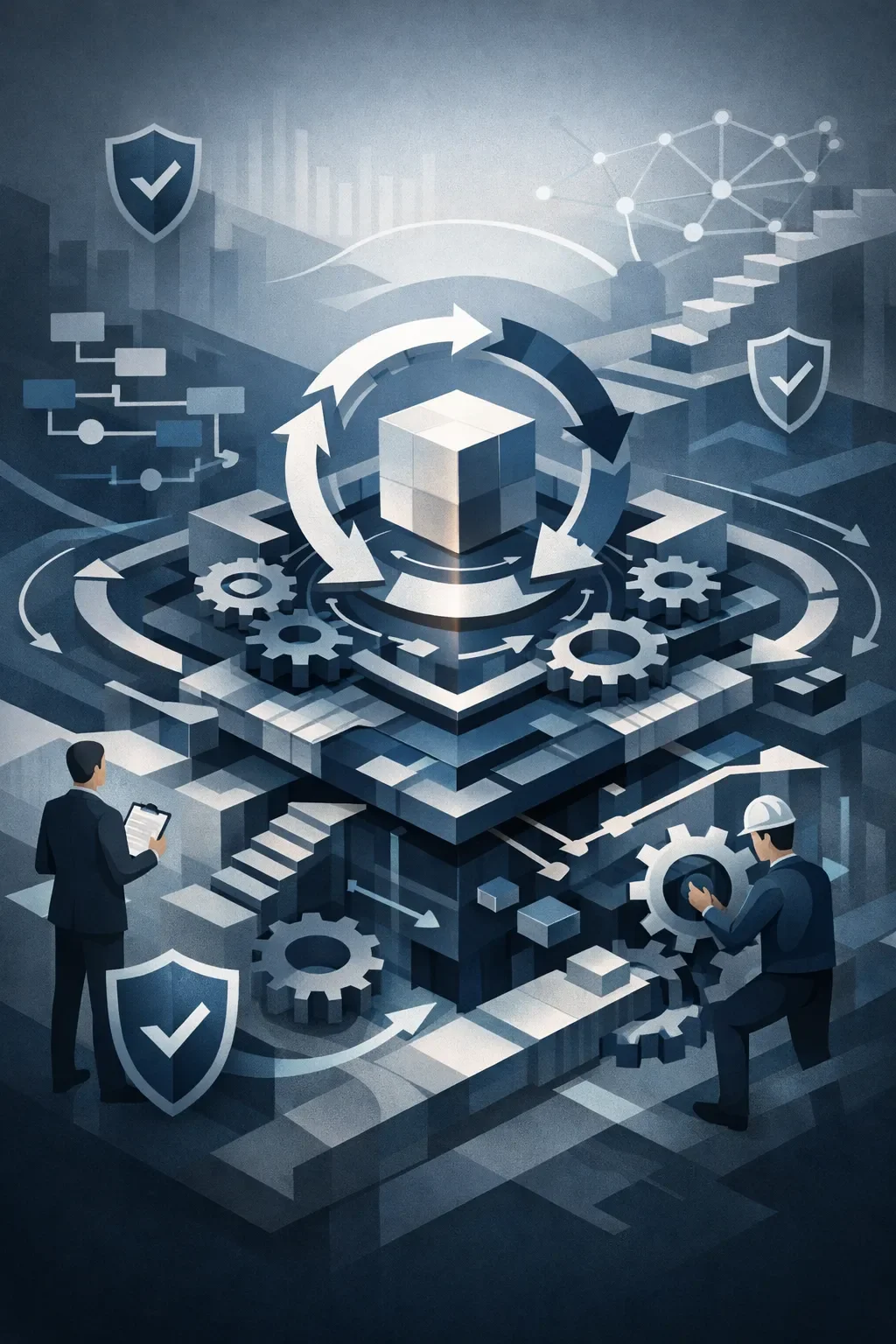
Structured change management system with layered controls, gears, and circular flow illustrating controlled transformation across interconnected operations
What Change Management Consulting Actually Is
Change management consulting is the structured design and control of how organizational change is introduced, executed, and stabilized.
It operates at the intersection of:
Governance (who decides, approves, and owns change)
Operations (how change affects processes and workflows)
Risk (what could go wrong and how it is controlled)
People (how behavior and accountability shift)
Most organizations assume change is a project.
In practice, change is a system.
Without structure, change becomes:
Inconsistent across departments
Poorly communicated
Weakly controlled
Difficult to sustain
Resistant at the operational level
This is why change management often aligns closely with broader frameworks such as ISO Management System Consulting, where structured governance is already expected.
What Change Management Consulting Covers
A structured change management approach does not focus on one area. It connects multiple layers of the organization.
Readiness and Stakeholder Alignment
Assessment of cultural readiness, sponsorship strength, governance structures, and operational dependencies before launch
Mapping affected departments and leadership roles, including their incentives, concerns, and operational risks
Visible leadership sponsorship and engagement plans that support adoption across departments
Formal management system implementation often triggers governance, process ownership, and accountability change simultaneously. Many organizations pair this work with an ISO Gap Assessment to evaluate technical and organizational preparedness.
Governance and Control
Definition of change categories (strategic, operational, regulatory, system-level)
Approval and authorization structures
Change ownership and accountability models
Integration with leadership decision-making
Transformation roadmaps with milestones and governance checkpoints aligned to operational priorities
Process and Operational Impact
Mapping how change affects existing workflows
Identifying dependencies across departments
Defining transition states between current and future processes
Establishing control points during implementation
Risk and Control Integration
Identification of change-related risks
Alignment with existing risk management frameworks
Definition of mitigation and monitoring controls
Escalation and issue handling structures
Communication and Adoption
Structured communication aligned to roles and impact levels
Targeted stakeholder engagement
Training aligned to operational change (not generic awareness)
Reinforcement mechanisms to sustain adoption
Leadership coaching for transformation sponsors and role-specific training for impacted teams
Verification and Sustainment
Measurement of whether change is actually working
Auditability of change execution
Feedback loops into corrective action processes
Integration into ongoing management review
KPIs tracking adoption progress, resistance patterns, and where intervention is needed
This is why change management is often embedded within broader initiatives like Implementing a System or Maintaining a System, where change is continuous rather than one-time.
How Change Management Consulting Works
A structured engagement does not begin with communication plans. It begins with understanding how the organization currently handles change.
1. Current State Assessment
The first step is evaluating how change currently flows through the organization.
This includes:
How decisions are made
How changes are communicated
How implementation is controlled
Where breakdowns occur
Most organizations discover that change is informal, inconsistent, or undocumented.
2. Change Architecture Design
Once gaps are understood, a structured model is designed.
This typically includes:
Change classification framework
Defined lifecycle (initiation → approval → implementation → verification → closure)
Roles and responsibilities across functions
Integration with existing systems (quality, risk, compliance, operations)
At this stage, change management becomes an operating structure, not a concept.
3. Process Integration
Change management does not operate in isolation. It must connect to:
Risk management processes
Quality or compliance systems
Project management structures
Operational workflows
For organizations with formal systems, this often aligns with frameworks like ISO 9001 Quality Management System, where controlled change is already a requirement.
4. Implementation and Enablement
The model is then operationalized.
This includes:
Developing procedures and control mechanisms
Defining documentation expectations
Training leadership and operational roles
Establishing tracking and monitoring tools
The goal is not to introduce complexity. It is to introduce clarity and control.
5. Monitoring and Improvement
Once implemented, the system must prove it works.
This involves:
Measuring adoption and effectiveness
Identifying failures or resistance points
Feeding issues into corrective action processes
Refining the model based on real performance
This is where change management becomes sustainable rather than reactive.
Where Organizations Get Change Management Wrong
Most change management efforts fail for predictable reasons.
Treating Change as Communication
Organizations assume that if people are informed, change will happen.
In reality:
Communication without structure creates awareness, not control
Messaging does not resolve operational conflicts
Adoption requires system-level alignment
Inconsistent messaging drives transformation fatigue over long implementation cycles
Lack of Ownership
Change is often assigned broadly but owned by no one.
This leads to:
Diffuse accountability
Delayed decisions
Inconsistent execution
Effective change management defines ownership clearly at every stage.
Engaging Stakeholders Too Late
Change initiatives often fail because stakeholders are identified too late.
This leads to:
Resistance from teams whose incentives and concerns were never understood
Weak leadership sponsorship when leaders are not visibly engaged early
Effective change management brings affected departments and leadership roles in before implementation begins.
Ignoring Process Impact
Changes are introduced without understanding how they affect existing workflows.
This results in:
Workarounds
Conflicting procedures
Operational inefficiencies
Change must be mapped against real process execution, not assumed.
No Verification Mechanism
Many organizations implement change but never confirm whether it worked.
Without verification:
Failures go unnoticed
Issues accumulate
Systems degrade over time
This is why change management must connect to audit and review structures such as Conducting an Audit.
Treating Change as One-Time
Organizations approach change as a project rather than a continuous capability.
In reality:
Change is constant
Systems evolve
External requirements shift
Without a sustained model, organizations repeat the same failures.
What a Change Management Engagement Looks Like
A consulting engagement is not about delivering templates. It is about building a working system.
Typical phases include:
Discovery and Alignment
Understand organizational structure and decision-making
Identify current change management practices
Define objectives and scope of change control
System Design
Develop change management framework
Define lifecycle and governance structure
Align with existing systems and processes
Implementation
Build procedures and supporting tools
Train leadership and operational stakeholders
Launch controlled implementation
Operational Integration
Embed change management into daily operations
Align with risk, quality, and performance systems
Establish monitoring and reporting mechanisms
Continuous Improvement
Evaluate effectiveness of change processes
Identify recurring issues or bottlenecks
Refine system based on operational feedback
This approach aligns closely with structured consulting methodologies reflected in ISO 20700 Management Consultancy, where advisory work is expected to be systematic, transparent, and outcome-driven.
Key Deliverables
Engagements produce structured deliverables that support implementation and long-term sustainability.
Deliverables typically include:
A change management roadmap with milestones, governance checkpoints, and adoption metrics
Organizational readiness and gap assessment reports establishing baseline readiness metrics
Stakeholder engagement and alignment plans, plus a strategic communication framework
Training materials and coaching resources for leaders and impacted teams
Resistance and risk mitigation strategies for the transformation initiative
A final transformation review with recommendations and lessons learned
Strategic Value of Change Management Consulting
Organizations that implement structured change management gain more than smoother transitions.
They gain control over how the organization evolves.
Risk Reduction
Changes are evaluated before implementation
Impacts are understood and controlled
Failures are identified early
Operational Stability
Changes do not disrupt core operations unpredictably
Dependencies are managed
Transition states are controlled
Faster Implementation
Clear ownership reduces delays
Defined processes reduce confusion
Decision pathways are structured
Audit and Compliance Readiness
Changes are documented and traceable
Decisions are justified and controlled
Evidence exists for audits and assessments
Organizational Alignment
Leadership decisions translate into execution
Departments operate with shared understanding
Resistance is addressed structurally, not reactively
Who This Service Is For
This service supports organizations undertaking complex operational transformation.
Typical engagements include:
Companies implementing new management systems alongside broader organizational transformation
Organizations undergoing structural or leadership changes that disrupt established decision-making
Firms introducing enterprise technology platforms that require new processes and adoption
Regulated organizations implementing compliance frameworks that change how work is controlled
Companies integrating multiple operational standards into one coordinated management system
Work Directly with a Senior Consultant
Wintersmith Advisory engagements are led directly by our principal consultant, with senior-level advisory involvement from start to finish and practical guidance grounded in management system expertise.
Our goal is not to create dependency. It is to equip organizations with the leadership alignment, governance structure, and operational clarity required to sustain change independently.
How Change Management Connects to Broader Systems
Change management rarely stands alone.
It typically integrates with:
ISO Risk Management Consulting initiatives for risk alignment
Business Process Consulting for operational redesign
Process Improvement Consulting for performance optimization
Operational Resilience Program for continuity under disruption
This reinforces a key point:
Change management is not a standalone service. It is a core component of how modern organizations operate.
If You’re Also Evaluating…
ISO Compliance Services for organizations building formal governance around regulatory or certification requirements
ISO Implementation Consultant support when a new management system rollout drives the change
Contact us.
info@wintersmithadvisory.com
(801) 477-6329