
Environmental Standards ISO
Organizations searching for environmental standards ISO are typically trying to understand which ISO frameworks govern environmental responsibility, sustainability, and environmental risk management.
Environmental ISO standards provide structured frameworks for organizations to manage environmental impacts, comply with regulatory obligations, and improve sustainability performance through disciplined management systems.
These standards are widely used across manufacturing, technology, energy, construction, and service sectors where environmental performance is increasingly tied to regulatory expectations, investor scrutiny, and customer requirements.
Understanding how environmental ISO standards work helps organizations move beyond ad hoc sustainability initiatives and implement structured, auditable environmental governance.
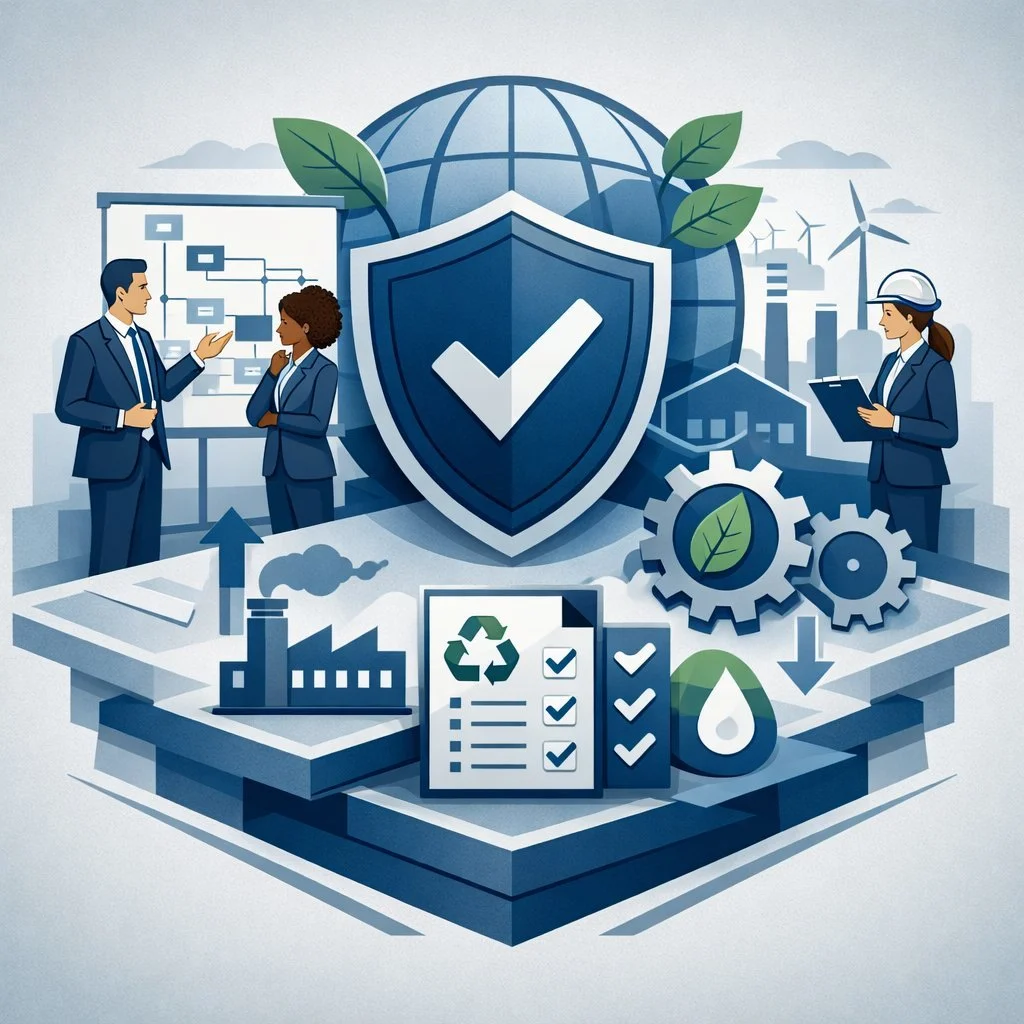
What Are Environmental ISO Standards?
Environmental ISO standards are internationally recognized frameworks developed by the International Organization for Standardization to help organizations manage environmental responsibilities in a systematic and measurable way.
These standards focus on:
Environmental impact identification and control
Resource efficiency and pollution reduction
Regulatory compliance management
Environmental risk evaluation
Sustainability performance monitoring
Continual improvement of environmental practices
The most widely adopted environmental framework is ISO 14001, which establishes the requirements for an Environmental Management System (EMS).
Organizations implementing these systems often work with an experienced ISO 14001 Consultant to align environmental governance with operational processes and audit expectations.
Environmental ISO standards are designed to integrate easily with other ISO management systems, allowing companies to coordinate environmental management with quality, safety, and risk governance.
The Most Important Environmental ISO Standards
While many ISO standards touch environmental issues, several are specifically focused on environmental management and sustainability.
ISO 14001 — Environmental Management Systems
ISO 14001 is the core global standard for environmental management systems.
It provides a structured framework for identifying environmental impacts, controlling operational risks, and improving environmental performance over time.
Organizations implementing ISO 14001 establish systems for:
Identifying environmental aspects and impacts
Managing environmental legal and regulatory obligations
Establishing environmental objectives and performance metrics
Controlling pollution and waste generation
Monitoring environmental performance indicators
Conducting environmental internal audits
Organizations preparing for certification commonly implement the system through structured projects such as ISO 14001 Implementation initiatives that align environmental practices with operational processes.
ISO 14064 — Greenhouse Gas Management
ISO 14064 focuses specifically on greenhouse gas measurement, reporting, and verification.
It is frequently used by organizations participating in carbon reporting programs, emissions reduction initiatives, and ESG reporting frameworks.
ISO 14064 helps organizations:
Quantify greenhouse gas emissions
Establish emissions baselines
Develop reduction strategies
Support external verification of emissions data
Companies implementing climate disclosure programs often combine this standard with broader sustainability governance initiatives under Environmental, Social, & Governance frameworks.
ISO 50001 — Energy Management Systems
ISO 50001 focuses on structured energy management and energy performance improvement.
The standard supports organizations in reducing energy consumption, lowering operating costs, and improving environmental sustainability.
Energy management systems typically include:
Energy performance indicators
Energy usage monitoring and analysis
Operational controls for energy-intensive processes
Energy efficiency improvement initiatives
Organizations implementing structured energy governance frequently work with an experienced ISO 50001 Consultant to integrate energy performance management into existing environmental systems.
ISO 37101 — Sustainable Communities
ISO 37101 addresses sustainability at the community and municipal level.
It provides guidance for governments and organizations seeking to manage sustainability across urban infrastructure, environmental impact, and social well-being.
This standard supports:
Sustainable infrastructure planning
Environmental impact reduction in urban development
Long-term sustainability strategy
Municipal sustainability initiatives often connect these frameworks with broader governance models such as ISO 37101 Sustainable Communities programs.
Why Organizations Adopt Environmental ISO Standards
Environmental ISO standards are increasingly adopted for both regulatory and strategic reasons.
Key drivers include:
Regulatory pressure for environmental compliance
Customer sustainability requirements
Investor scrutiny regarding environmental performance
Supply chain environmental responsibility expectations
Corporate sustainability commitments
Risk reduction and operational efficiency
For many organizations, environmental management systems are implemented as part of broader governance frameworks supported by ISO Compliance Services.
This approach ensures environmental governance is integrated with quality, safety, and operational management systems.
Core Requirements of ISO Environmental Management Systems
Although individual standards differ, most environmental ISO systems share common management system requirements based on the Annex SL structure used across modern ISO frameworks.
Organizational Context and Environmental Scope
Organizations must identify:
Environmental conditions affecting operations
Internal and external environmental risks
Regulatory and stakeholder expectations
Environmental aspects of products and services
Defining system scope is essential for certification readiness.
Environmental Policy and Leadership Commitment
Top management must establish a documented environmental policy that commits the organization to:
Pollution prevention
Legal compliance
Environmental performance improvement
Sustainable resource management
Leadership involvement is critical for system credibility.
Environmental Risk and Impact Assessment
Environmental management systems require systematic evaluation of environmental impacts, including:
Emissions to air and water
Waste generation and disposal
Resource consumption
Chemical usage
Energy usage
Risk-based thinking ensures environmental controls focus on the most significant environmental impacts.
Environmental Operational Controls
Organizations must establish procedures and operational controls to manage environmental risks.
Examples include:
Waste management procedures
Chemical handling protocols
Environmental monitoring programs
Supplier environmental requirements
These operational controls become part of everyday business processes.
Environmental Monitoring and Performance Evaluation
Organizations must measure environmental performance and track improvement over time.
This includes:
Environmental KPIs and performance metrics
Environmental monitoring systems
Internal environmental audits
Corrective action processes
Environmental systems must demonstrate measurable improvement over time.
Many organizations strengthen system credibility through structured internal reviews such as ISO 14001 Audit programs.
Environmental ISO Certification Process
Organizations seeking certification to ISO environmental standards typically follow a structured process.
Step 1 – Environmental Gap Assessment
A gap assessment compares current environmental practices against ISO requirements.
Common findings include:
Incomplete environmental aspect registers
Weak regulatory compliance tracking
Lack of environmental performance monitoring
Limited management oversight
Structured reviews like an ISO Gap Assessment help organizations identify these gaps before formal implementation.
Step 2 – System Implementation
During implementation, organizations establish:
Environmental policies and objectives
Environmental aspect identification systems
Environmental monitoring and measurement programs
Environmental operational controls
Internal audit programs
Companies frequently rely on structured implementation services such as ISO 14001 Implementation to accelerate system development.
Step 3 – Internal Audit and Management Review
Before certification, organizations must conduct:
Full-scope internal audits
Management review meetings
Corrective action closure
These activities confirm system readiness.
Step 4 – Certification Audit
Certification occurs in two stages:
Stage 1 — Documentation and readiness review
Stage 2 — Verification of operational implementation
Certification is typically valid for three years with annual surveillance audits.
Common Mistakes When Implementing Environmental ISO Standards
Organizations frequently struggle with environmental ISO implementation when systems are treated as documentation exercises rather than operational management frameworks.
Common mistakes include:
Treating environmental management as a compliance checklist
Weak environmental aspect identification
Incomplete regulatory compliance tracking
Poorly defined environmental performance metrics
Lack of leadership engagement
Failure to integrate environmental governance with operational decision-making
Environmental ISO standards are management systems, not documentation projects.
Organizations that integrate environmental governance into operational management achieve significantly stronger outcomes.
Integrating Environmental Standards with Other ISO Systems
Environmental management systems integrate naturally with other ISO frameworks due to shared structural design.
Common integrations include:
Quality management systems
Occupational health and safety systems
Information security governance
Enterprise risk management programs
Organizations implementing multiple ISO frameworks often coordinate governance through an Integrated ISO Management Consultant who aligns documentation, audit programs, and risk management processes across standards.
This integration reduces duplication and improves management system efficiency.
Benefits of Environmental ISO Standards
When implemented effectively, environmental ISO standards deliver significant organizational benefits.
These benefits include:
Reduced environmental risk exposure
Improved regulatory compliance readiness
Lower resource consumption and operating costs
Stronger sustainability credibility with customers and investors
Improved operational discipline
Clear environmental governance structure
Environmental management systems also strengthen strategic risk management by aligning environmental performance with broader governance initiatives such as Enterprise Risk Management.
Next Strategic Considerations
Organizations researching environmental ISO standards often evaluate these related frameworks and services:
A structured environmental management system does more than reduce environmental impact. It provides governance discipline, regulatory defensibility, and measurable sustainability performance aligned with modern operational risk expectations.
Contact us.
info@wintersmithadvisory.com
(801) 477-6329