
GRC Framework
If you are evaluating a GRC Framework, you are usually trying to solve a more serious problem than policy organization.
You may be asking:
How do we govern compliance activities without creating silos?
How do we connect risk decisions to actual business operations?
How do we keep governance and oversight from becoming reactive?
What should a GRC Framework actually include?
How do we build a framework that is practical, not theoretical?
A GRC Framework is a structured model for managing governance, risk, and compliance in a coordinated way. It gives an organization a consistent way to define accountability, identify and evaluate risk, meet obligations, monitor control performance, and drive improvement.
Done well, it creates clarity. Done poorly, it becomes a disconnected collection of spreadsheets, controls, audits, and executive updates that do not actually support decision-making.
This page explains what a GRC Framework is, what it should contain, where organizations usually struggle, and how to build one that supports real operational control.
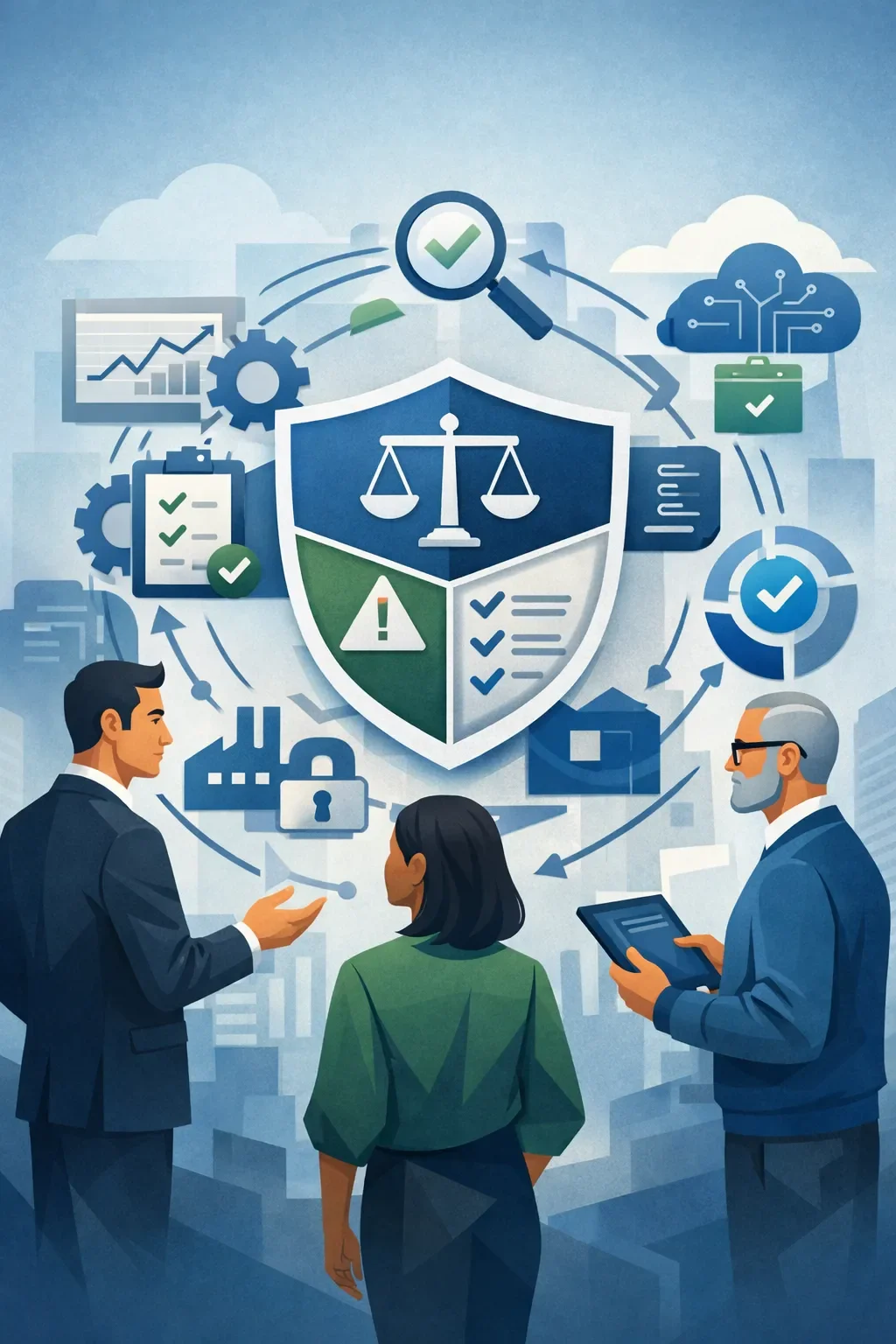
What Is a GRC Framework?
A GRC Framework is the structure an organization uses to manage three connected disciplines:
Governance
Risk management
Compliance management
Governance defines who is responsible, how decisions are made, what is monitored, and how leadership exercises oversight.
Risk management defines how uncertainty, disruption, control failure, and strategic exposure are identified and addressed.
Compliance management defines how the organization understands and meets legal, regulatory, contractual, customer, and internal requirements.
The reason these belong together is simple: they influence one another constantly.
A compliance obligation creates governance expectations. A governance failure creates risk. A risk treatment may require a new control, policy, monitoring activity, or audit. If these pieces are managed separately, the organization loses visibility and spends more time reconciling work than improving control.
Organizations that want a broader view of this operating model often start with Governance Risk and Compliance before defining the deeper structural requirements of a working framework.
Why Organizations Need a GRC Framework
Most organizations do not begin with a formal GRC Framework. They accumulate one.
They add policies when customers ask for them. They add risk registers after incidents. They add audits after a finding. They add committees after leadership realizes accountability is unclear. Over time, they end up with activities that sound mature but do not operate as a system.
That is usually when the need for a framework becomes obvious.
A strong GRC Framework helps an organization:
Clarify roles, decision rights, and escalation paths
Connect enterprise risks to operational controls
Consolidate compliance activities across overlapping obligations
Improve audit readiness and control defensibility
Reduce duplicated effort across teams
Provide leadership with decision-useful reporting
Support scaling without losing oversight discipline
For organizations trying to make this operational, GRC Consulting Services can help translate the concept into governance structures, workflows, registers, reporting logic, and implementation priorities.
The Core Components of a GRC Framework
A GRC Framework should not be defined as a vague commitment to accountability and compliance. It needs working components.
Governance Structure
Governance is the operating backbone of the framework. It defines how oversight actually happens.
This usually includes:
Leadership roles and assigned authorities
Committees, forums, or review structures
Approval and escalation pathways
Policy ownership
Reporting expectations
Review cadence for risk, compliance, and control performance
Without clear governance, risk and compliance work becomes fragmented and largely reactive.
Organizations working to formalize leadership oversight often align GRC design with Corporate Governance Consulting principles so responsibility and reporting do not remain informal.
Risk Management Model
A GRC Framework needs a defined way to identify, assess, prioritize, respond to, and monitor risk.
That means more than maintaining a list of concerns. It means defining:
Risk categories
Assessment criteria
Ownership
Treatment expectations
Review triggers
Thresholds for escalation
Links between risks, controls, and business objectives
This is where many organizations realize they are doing risk discussions, not risk management.
For companies that need a stronger enterprise structure, Enterprise Risk Management Consultant work often becomes the bridge between high-level risk conversations and a disciplined framework.
Compliance Obligation Structure
Compliance cannot live as a passive archive of regulations and customer terms. A functioning GRC Framework identifies what requirements apply, why they matter, who owns them, how compliance is monitored, and what evidence supports conformity.
That typically includes:
Legal and regulatory obligations
Contractual obligations
Customer-specific requirements
Internal policy commitments
Industry framework requirements
Assigned owners and monitoring methods
Where organizations fail here is not usually lack of awareness. It is lack of structure.
A strong framework makes obligations visible, traceable, and reviewable. For some organizations, this overlaps directly with a broader Compliance Management System rather than being handled as a separate compliance spreadsheet.
Policies, Controls, and Procedures
The framework should define how governance expectations and compliance obligations become operational controls.
That includes the relationship between:
Policies
Standards
Procedures
Control activities
Monitoring mechanisms
Evidence of performance
If controls exist without clear ownership or documentation logic, the framework will not scale. If policies exist without measurable control execution, the framework will not hold up under audit or executive scrutiny.
Monitoring, Audit, and Review
No GRC Framework is complete without a structured way to evaluate whether it is working.
This should include:
Control monitoring
Internal audit or assurance activity
Management review or leadership review
Issue tracking
Corrective action
Trend analysis
Periodic framework updates
The framework must tell the organization not only what should happen, but how it will know whether those things are actually happening.
Reporting and Decision Support
A GRC Framework should improve decision quality. That means the framework has to produce reporting leadership can use.
Useful GRC reporting is not a flood of status updates. It should help leadership understand:
Material risks
Control weaknesses
Compliance gaps
Trends
Escalations
Resource needs
Decisions requiring action
If reporting is disconnected from action, the framework is only administrative.
What a Practical GRC Framework Looks Like
A practical GRC Framework is not built around abstract maturity language. It is built around operating clarity.
At a minimum, the organization should be able to answer these questions clearly:
What are we obligated to comply with?
What are our most significant risks?
Who owns each major risk and obligation?
What controls are meant to address them?
How do we know those controls are working?
What gets escalated, to whom, and when?
How does leadership review performance and act on results?
If those answers are inconsistent across departments, the framework is not mature yet, regardless of how many documents exist.
Organizations often need stronger alignment between strategic oversight and operational execution. That is where Enterprise Risk Management becomes especially relevant, because the framework has to connect enterprise exposure with business-level action.
Common GRC Framework Failures
Most weak GRC Frameworks do not fail because the organization lacks effort. They fail because the structure is incomplete.
Common failure points include:
Governance roles are implied, not defined
Risk criteria are inconsistent across teams
Compliance obligations are tracked but not actively monitored
Controls are undocumented or weakly owned
Reporting is descriptive rather than decision-oriented
Audit findings do not feed into framework improvement
Technology is added before process logic is stable
One of the most common mistakes is treating GRC as a software implementation. Tools can support a framework, but they do not create one. If roles, risk logic, control structure, and review processes are unclear, software only makes the confusion more visible.
GRC Framework vs. GRC Program
These terms are often used interchangeably, but they are not exactly the same.
A GRC Framework is the structural model. It defines the rules, relationships, responsibilities, and methods.
A GRC program is the active operation of that framework. It includes the actual reviews, reporting, risk assessments, audits, updates, and corrective actions.
The framework is the design. The program is the execution.
Organizations that are ready to move from concept to operation usually need GRC Framework Implementation support because implementation requires more than writing a model. It requires building workflows, ownership, cadence, and usable outputs.
How GRC Frameworks Connect to Other Standards and Models
A GRC Framework often becomes the integrating structure behind multiple standards, regulations, and customer obligations.
Depending on the organization, that may include:
Information security requirements
Privacy requirements
Internal control requirements
Supplier oversight requirements
Operational risk governance
Industry-specific regulatory obligations
For cybersecurity-heavy organizations, GRC work often aligns naturally with NIST Cybersecurity Framework because governance, risk prioritization, and control management all need a coherent operating model.
For organizations formalizing information security governance, ISO 27001 Consultant work is often adjacent because ISO 27001 depends on clear governance, risk assessment discipline, control accountability, and evidence-based oversight.
For organizations balancing customer-driven trust requirements, SOC 2 Compliance may also be part of the same governance model, particularly where control monitoring and assurance reporting need to be aligned.
And where external dependency exposure is material, Third Party Risk Management should not sit outside the framework. Vendor and supplier risks belong inside the same oversight structure, not in a disconnected procurement process.
When a GRC Framework Becomes Necessary
A formal GRC Framework becomes especially important when an organization is experiencing one or more of the following:
Growth is outpacing oversight discipline
Multiple compliance obligations are starting to overlap
Leadership wants clearer risk visibility
Audit activity is increasing
Customers are asking harder governance questions
Control ownership is unclear across departments
Risk, compliance, and internal audit efforts are duplicated
The organization is trying to scale with fewer surprises
In smaller organizations, the framework may remain relatively lean. In more complex organizations, it often becomes the central logic behind governance committees, risk registers, control libraries, internal audit, and compliance review.
Either way, the principle is the same: the framework should make oversight more coherent and more usable.
How to Build a Strong GRC Framework
A disciplined build usually follows this sequence:
1. Define Governance Expectations
Clarify ownership, decision rights, reporting lines, review forums, and escalation rules.
2. Identify Requirements and Risk Domains
Document the obligations, risk categories, and strategic exposures that the framework needs to cover.
3. Establish Risk and Control Logic
Define how risks are assessed, how controls are linked, and how performance will be monitored.
4. Create Monitoring and Review Cadence
Set expectations for audits, reviews, reporting, corrective action, and leadership evaluation.
5. Build Reporting Around Decisions
Make sure outputs support prioritization, escalation, and resource allocation rather than passive documentation.
6. Improve Through Use
Refine the framework based on findings, incidents, growth, and shifts in business context.
This is also where organizations sometimes benefit from ISO 31000 Consultant support if they want a more structured risk architecture behind the framework.
Is a GRC Framework Worth Building?
For organizations facing regulatory exposure, customer scrutiny, scaling complexity, or executive pressure for stronger oversight, the answer is usually yes.
A GRC Framework gives structure to work that otherwise becomes fragmented and increasingly expensive to manage. It improves visibility. It reduces duplication. It strengthens accountability. Most importantly, it helps leadership make better decisions with a clearer view of obligation, exposure, and control performance.
A good framework does not create bureaucracy for its own sake. It creates disciplined visibility and usable control.
If You’re Also Evaluating…
Contact us.
info@wintersmithadvisory.com
(801) 477-6329